27 Jun 2020

Lizard Brain and the Psalms


            I have recently had a few helpful conversations with friends about what we're calling "Lizard Brain". The limbic system, which addresses our most basic and emotional reactions and needs (food, fight or flight, etc.), is fairly basic, and thus most like a lizard's. It focuses on the immediate here and now, the instinctive reaction, often induced by stress, and without much pause-and-reflect action going on.
            In this COVID-time, many of us are reacting from this space. We're in distress, we're on alert, we're hyper-aware to threats. Our instincts have taken over, and often we find ourselves doing things without necessarily thinking it through (like eating a whole bag of popcorn without realising it, or getting through a workday "on auto-pilot").
            We are reacting to the world around us.
            What my friends were discussing is that this means we are often reacting to one another, in person and on social media, without the benefit of a pause-and-reflect. We are making decisions without gaining complete information, we are commenting without seeking the full story. We are not responding, but reacting.
            While our bodies may think that we're under siege, and it's eat-or-be-eaten, we need to be careful to remember that the vast majority of us are NOT experiencing an imminent threat. We need to take a deep breath, pause, and reflect - so that we do not merely react but respond, in an appropriate and intentional manner.
            To put it biblically: we need the Selah of the psalms[1].
            Selah: a word whose precise meaning is no longer known, a musical notation understood to mean that the people praying and singing the psalm were intended to pause for a moment, to stop and listen at what was happening. To be intentional to the teaching of the psalm, to be present to the full experience of that prayer. Selah - a holy pause before moving on.
            What a wonderful message for us to hear then, as we continue to strive to be the community of God's children despite these difficult times. We are invited to pause - to engage in a holy moment of sober second thought - a sacred space to move away from emotional-only reaction to an intellectually-balanced response. Selah: a divine gift for humans!
            So while God also loved the lizards into creation, it's not what God intended when we were loved into creation as humans. Let's leave the lizarding to the lizards. Selah.


[1] Selah is found 71 times in the psalms and 3 times in the book of Habakkuk.


20 Jun 2020

Let Us Sing to the Lord!


            Part of the Divine Office is the daily declaration of Psalm 95, which begins with an exultation to praise God: Come, let us sing to the Lord; let us shout for joy to the Rock of our salvation. Let us come before God’s presence with thanksgiving; and raise to the Lord a shout with psalms.
         I recently pondered: when do we do that?
         Aside from the singing part - which may happen now in showers and in cars, but not in gatherings...  How often do we sing praises to God? When was the last time we shouted for joy as a result of God's presence in your life?
         Admittedly - if we started to take this literally, our neighbours may think we're *really* not handling the health restrictions well.
         But... music is a reality in our lives. People sing, or hum, just about anywhere. This week I heard others singing at the grocery store, at the office, in their gardens, at the park... I know I was singing in the car, and while walking the dogs, and...
         We sing. And so we have the chance to sing our prayers. For that is what psalms are: poetic prayers intended to be sung, as celebrations or laments on holy occasions.
         The beauty of this is: any day can be a holy day, when we decide to honour God. I think this is why Psalm 95 starts our morning prayer - encouraging a daily orientation to praise with song, that gift that combines both abstract and concrete thinking. It is said "the one who sings, prays twice" - perhaps we can start our day then, even if alone in the shower, with a song in our heart and a psalm in our minds.
         So: Come, let us bow down and bend the knee, and kneel before the Lord our Maker. ... Oh, that today we would hearken to your voice!


13 Jun 2020

Welcome Home!


Glamour Dog?
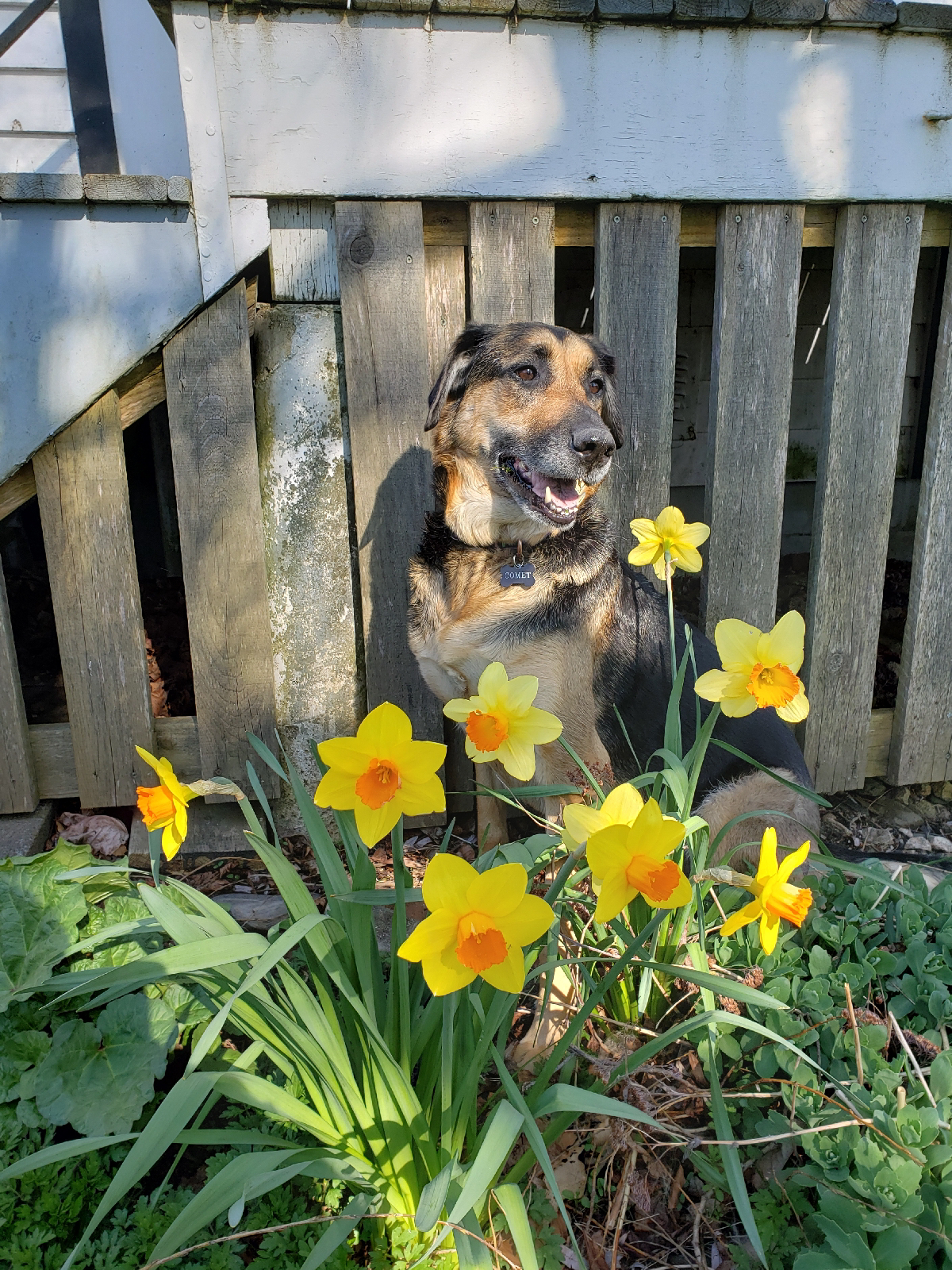
            Six months ago today, I got a new roommate: a timid, gentle dog with soul-searching eyes and a purple toy elephant. Comet (as she began to be called) came with some not-so-great history, but had been loved a lot by her foster humans, and she responded to her new situation as might be expected.
            She had no idea how long it might last. She wanted things to be stable. She wanted to be safe. She wanted consistency.
            It's said that with re-homed dogs, it takes about 3 days to de-stress from the sudden change, about 3 weeks to learn a new routine and environment, and about 3 months before they know what 'home' truly means. With Comet, I was reminded that this applied to me, and to Watson, as well! It's also recommended to establish the ground rules form the start, beginning as you mean to continue.
            So: off we set. Being gentle and patient, we learned our boundaries, and we deepened our relationship. Basic boundaries are understood (she would sleep on the bed but not soil the carpet; any toy from the dog box was fair to play with, but eating the puzzle pieces is *strongly* discouraged).
            And we gradually set into a rhythm. She's not timid anymore, she has a favourite window to bark from, she knows what it means when I head towards the leash door. She's a smart girl, and a great part of the family. It's not perfect (I have a few puzzles that are now creatively 999-pieces, and some table-begging still happens), but it's good. Our new reality is lovely, because we all decided we would make it that way.
            So what about us? It's almost 3 months ago today we were all thrust into a different way of being: a sudden change, a new way of being, a different way of understanding relationship, rapidly changing rules that we don't always understand. It's a lot to take in! The changes that we have endured are enough to make us dizzy, and they continue to change. And we have been without the comfort of consistency, or the assurance of answers to our questions.
            So what can we do? Well, as with any big change: we can be gentle and patient with ourselves, and with each other. We won't always get it right, but it's part of the journey. In the midst of what we don't know, there's so much that we DO know.
            We know that we are loved. We know we are cared for. We know we are not alone. We know that our well-being is a priority. We know that it's okay to have our good days and not-so-good days. We know that we are wanted. We know that we are 'home'. And we know that - whatever changes - we are going to be okay.
            We can take our time - to de-stress, to learn new patterns of living, and to have a new understanding of home.
            So we adapt - we adjust - we adopt new practices and ways of being, and in doing so we are embraced in the love of God and the love of community. We find a new understanding of what our lives will be like, and we put our energy to the things that matter most to us - our faith being a high priority. And our true selves emerge.
            And so: we embrace the calmness, gentleness, and patience that comes from hearing (yet again!) the voice of Jesus say "welcome home."

6 Jun 2020

Turning the Page


            I have a 'dogs under water' calendar hanging in my kitchen, with each month hilariously highlighting a dog trying to catch a ball thrown into a pool. And while 2020 calendars may not have been the best investment, May's dog picture seemed quite fitting - the poor pupper is eagerly headed in a different direction from the ball. (A great analogy to how we feel in COVID, chasing the elusive moving target of 'normalcy'.)
            I noticed this week that despite this adorableness, it was no longer May. And thus, it was time to flip the calendar. This is not a difficult task; yet I found myself delaying.
            Part of it was that I liked what was there - and so I wanted to maintain it. I hadn't taken a peak at June's dog and made a conscious choice to stick with May, I don't think I was making a subconscious existential analysis rejecting time's passing; I just liked where I was at. But yesterday I turned the page: acknowledging that to leave it in May was both unhelpful and denied me the possibility of what was yet to come.
            Turning the page in our lives, however, can be hard work. And we, as a society, and as a church, are facing the undeniable truth that it's time to turn a page. How we gather, how we will use our buildings, how our whole society will function is going to be very different for a while. And while we are stunned by this (and rightly so!) it is time for us to turn the page.
            Certainly, when it comes to church, we don't know yet what that will look like. Because we have become comfortable with what is comfortable - and we have resisted the concept of change. Even what looks like change may be a temporary adaptation (online services, for example, are merely a change of venue).
            What we have before us is both an opportunity and a need - to turn the page; and it comes with an uncontrollable external force. All that we do as church is going to look very different for a long time - worship, bible study, fellowship, youth ministry, sacramental ministry, pastoral care, the list goes on. And so we are now called to recognise that the past is passed, and we are able to prayerfully and carefully discern what is possible, what is feasible, and what is faithful.
            What was may have been great. And what is ahead can also be great. We won't know until we have the courage to turn the page. Just like the calendar - May was fantastic, but until I turned the page, I didn't know how great June would be (and it does not disappoint - as I now get to see a close-up of a very happy adorable chocolate lab!)
            Let's be confident that God is with us as we turn the page to a fantastic future.


30 May 2020

Leaning


            I spent several summers of my childhood and early adulthood at camp. (Entire summers! Camping, counselling, chaplain-ing. Bliss.) At one camp, I noticed a precocious pre-teen dominating conversation. Her friend interjected with a mocking "Well! I'm done talking about me. YOU talk about me now!" I watched this child have a powerful learning: it wasn't all about her.
            Life is like that. It's not all about *me*. It's not what I want, what I feel entitled to, what I lay claim to. It's about *us*. In our home lives, our social lives, our work lives, our faith lives. It's humbling and empowering to recognise that life is not meant to be an idolisation of the one, but a celebration of the community.
            And in community, we lose the arrogance, the ego, the always-rightness of being alone. We collaborate, we deliberate, we share. We lean on one another in tough times, we support one another in times of strength. We weave together a mosaic of gifts, skills, interests, and ministries. We don't impose but invite; we don't dictate but discuss, we don't exclude but engage.
            Community is why Jesus sent his disciples out in pairs or more; for safety (of body, mind, and spirit!), and in doing so He was pre-emptively minimising the rise of the ME, the "I have all the answers", the "I need to fix you" mentality, the "my Jesus is better than your Jesus."
            Community encourages leaning. It supports faith that struggles; it bolsters emotions that collapse; it upholds its membership. Letting ourselves lean on one another is not a sign of weakness, but an acknowledgement of our trust in and need for each other. And we can all lean together, as we need to: we know how several sticks leaning against each other stand - and can support other entities as well.
            And, friends, let's be honest, this is a week when we're leaning. We're weary from the isolation and fear of COVID. We're concerned (at best) by the breaking of our economic system, and the insecurity that brings. We lament the egregious abuses of power that result in death and destruction, of people, families, and communities.
            It's heavy. It's powerful. And alone, it's overwhelming, isolating, crushing. So lean. Lean as you need to. Trust that together, we will be supported. Trust that you're NOT in this alone. Trust that even in your leaning, you are offering support.
            And in that support: grow. As you lean, use some strength to prepare for the 'what's next' as we are challenged to engage with community in ways we could not have imagined would be needed 3 months ago. Learn about racism, about politics, about privilege, about broken systems, about poverty, about discrimination, about all the injustice that is out there. Because these are global realities, and call for global solutions; and we are called to be part of the solution. Together, supported, strong, educated. And leaning - even as we stand tall, and justice will bloom.


23 May 2020

Letting Go


"Mine. That's also mine. And future toys will be mine. Mine."
         We're at that time where windows are opening... and pedestrians going past my house are apt to hear a laughing "Drop it! Let it GO!" This is because my dog is NOT one to put down whatever she has in her mouth... usually a chew toy (preferably the one the other dog was playing with) or a puzzle piece (she likes cardboard), or some other form of canine entertainment.
         She had a dilemma recently, however. With a toy in her mouth (I was doing the obligatory play-chasing), she spotted another toy on the ground... Skidding to a stop, she stood there for quite some time, not willing to let go of the toy in her mouth, but also not willing to leave the toy on the ground.
         Tough decisions in dog-land! She tried to pick up both, but couldn't... she debated dropping the one for the other, but wouldn't... she did swap, but then swapped back. If I could see thought bubbles, I expect there would have been a lot of question marks arising.
         I reflected that there are times in all our lives when we have such decisions to make as well. What to hold on to, what to let go, admitting that sometimes we can't have both. What was meaningful 5 years ago may not be as significant in today's reality of our lives, and so we may be called to loosen our grip. What is important today will have been influenced by the past, but until we have space to let it enter our lives, we won't be able to reap the rewards.
         Wherever our energy and interests lie, we want to be able to focus. Be it a prayer practice, an outreach project, a course of study - whatever. We have a limited capacity (even us over-achievers) and therefore get to prayerfully and carefully decide what we want to be carrying.
         Letting go isn't easy, but it can be liberating. We can thank God for what was, and for the lessons we have learned; and ask God to reveal to us something new where our energy will be directed.
         So in this time of pandemic restrictions, when we are all at a space to consider what we value and cherish, we can consider what we're holding - and identify what we want to be holding - and give thanks to God for the holy experience of letting go.

16 May 2020

What Day Is It?

"Rotary time engine" CC BY-SA by plenty.r
Source: Flickr

            A recent theme in my life has been a shift in days... my weeks are now comprised of 2 days: Sundays, and Not-Sundays. My rhythm has become adapted in such a way that on Sundays, I post my weekly blog, and I lead worship from the right dining room corner at 8.30 and 10.30... and Not-Sundays I prepare the daily mailing, and lead prayers from the left dining room corner at noon.
            Almost everyone I've spoken with about this phenomenon has shared similar feelings. Our patterns are off; our schedules have changed, our day-to-day is different. We're all still busy, some of us moreso; but this different style of being is a gift.
            We're being gifted the opportunity to look at our busy-ness with new eyes... and determine how we want to spend our time and our energy. Each week of our shared physical distancing is a chance to engage with ourselves, our loved ones, and God, in different ways.
            It's helpful for me to frame this reality in the context of the early church, when ministry happened as it happened - without checking the colour-coded block in the agenda. For relationships and interactions to flow organically, without someone checking their watch or having a 'next meeting' reminder ping on their phone.
            It's also been helpful for me to consider how 'weeks' are understood in a spiritual sense - not as a counted passage of days, but as a stage of spiritual growth and development. The Ignatian Exercises, for example, are based on this principle, as are the stages of the rosary.
            So for me, this difference is reminding me that God is always calling me into deeper awareness, deeper reflection, deeper relationship. And while a global pandemic is not ideal for enforcing it, I can choose to make the most of the situation as it is: and to breathe deeply, pray consistently, and face each day with a thankful heart.
            So what day IS it? It's a day to connect with God. Amen; alleluia.