30 Sept 2023

Reflecting on Reconciliation

On the National Day for Truth and Reconciliation, we are invited to spend time reflecting on the legacy of the history of Residential Schools as a vital component of the reconciliation process.

Yesterday morning, as I was out and about, I overheard an encounter that influenced my day’s reflection. Unbidden, a man approached someone wearing an orange shirt, and emphatically engaged them by stating (unironically) that he was not to be told what to wear, and that he saw no need for reconciliation – “I didn’t do nothing!”

With more patience than I would have had, the other person tried to explain that their shirt supported the need to not stand idly or silently by. They also had not ‘done anything’ explicitly, but that we are all part of a system where we are in need of reconciliation. The gentleman was having none of it, and dismissively retorted “God will be my judge” before walking away.

Clearly, this individual was not interested in the journey towards reconciliation, nor even in having a conversation about our shared history.

And while we will all be judged by our creator, to use this truism as a means of shutting down discourse is often used as a means to avoid responsibility. Ignoring discussion about difficult topics does not resolve conflict, it disrespects the injured party and avoids accountability. It is a spiritually and emotionally immature response.

Admittedly, any conversation in which we identify and acknowledge the need for reconciliation is not going to be an easy one to have. However, choosing silence is seldom a good choice.

(I was reminded of the poem No Such Thing as the Innocent Bystander by Andrea Gibson, which reads ‘Silence rides shotgun / wherever hate goes.’)


The work of reconciliation is one where we need to commit to showing up. To listening, to learning, and to finding a way to do better. It’s about forging a new path forward with intentionality towards minimising hurt – and ideally healing some of the wounds of the past.

As Christians, we use the word reconciliation often. We have a sacrament of confession – in our Book of Alternative Services we call this the Reconciliation of a Penitent. (pp 166-172). The challenge, of course, is that it requires a penitent: someone who authentically desires to turn away from sin.

This turning away from sin (repentance) calls for action; for penance. It challenges us to change our ways of thinking and doing, so that we can correct our patterns of behaviour to do better. Penance is not about beating ourselves up for the past, but building ourselves up for the future. It is a form of spiritual healing where we dwell in the promise of forgiveness. This promise is not a magical ‘fix’ but a confidence that when we accept responsibility for our actions and do what is reasonable in order to make amends. (James 5.16a: Therefore confess your sins to one another, and pray for one another, so that you may be healed.)

And so we are called to seek reconciliation for our individual actions and for our societal ills. We confess our wrongs, known and unknown – and we are called to accept the challenge of the work before us. We don’t do this to avoid the work of reconciliation, but to request God's presence as a holy companion within it. For when we are genuine in our relationship with God, we are challenged to establish right relationship with all that God loves – including those we have injured or offended.

I don’t have easy answers for our journey in Truth and Reconciliation with Indigenous peoples. I don’t have easy answers for any journey that has led to broken trust and pain. But I do have faith that God will accompany us in all our journeys towards health and healing; and I pray that we will all continue to seek those right relationships.



23 Sept 2023

Truth In Advertising

I’ve spent some time this week scrolling through buy-and-sell groups on social media. Not surprisingly, I’ve been looking to purchase a few items for my new place, and I do prefer to get second-hand items when appropriate. (I do love a bargain!)

Some of the items have interesting descriptions… from the basic WYSIWYG (what you see is what you get) to some creative narratives about the history of the item, people publicise differently.

One commentary I’ve seen quite a bit of is a highly aspirational assessment of the item… “Brand new” or “Never used” or “10/10 condition!” It’s interesting, as many of these ads include photographs of items that are definitively NOT new or in perfect condition.

The imperfections on these items is not the problem – and in other ads, such imperfections are specified. The sellers want to make sure that potential buyers are fully aware of the flaws and weaknesses, so as to provide an honest and trustworthy experience.

When the description doesn’t line up with the item, it breaks trust. It means the seller is likely to be considered untrustworthy in future. Admittedly, it’s possible the person didn’t mean to be misleading or disingenuous, or that their emotional connection to an item has left them with ‘rose-coloured glasses.’

When these non-transactions happen, it can be frustrating, but such is the online marketplace. Yet these interactions have me considering how we represent ourselves when we are engaging with others about the church.

Obviously, we are all aspirational: we love our church, we want others to love our church. We have a passion for our community, and want to invite others to accompany us on our spiritual journeying.

So it’s important that we are transparent about who we are, when we are inviting folks to seek Jesus with us. It’s helpful to let folks know what we do well – and what our growing edges are. To share our moments of joy – as well as those times where we knew we needed to re-assess and adjust. To highlight where our engagement lies – and places where we are okay with others excelling.

When we are honest with ourselves about who we are and what we are doing, we can interact with the world around us with more integrity. And in doing so, we show our humility and our humanness: characteristics that can be quite appealing when someone is looking for an authentic faith community.

It’s helpful to remember that our churches are never perfect – nor are we! And to delight in the knowledge that that is okay. For God is with us – loving us - exactly as we are.


16 Sept 2023

Uniquely Colourful

I was buying paint this week... I have lots of walls to customise to my liking. I've spent some time considering what I wanted to do with the space, and made a decision. 

So, overtired and undercaffeinated, I went to the paint store to select some paint chips to take home - we all know that different lightning different spaces can have a substantial impact on how we perceive colour. 

While I was there the next morning, prepared with colour choices and room sizes, a man came in and asked the staff person to tell him what was popular. When the staff asked him about his preferences, the space, the furnishings, the lighting, etc., the man became increasingly frustrated. He just wanted what was popular.

So, the staff sold him a generic 'popular' colour. 

When it was my turn, the staff asked me some of the same questions, to which I was able to share my ideas and overall colour theme. (It's based on a favourite work of art, that I intend to be the centrepiece of the living room; pale blue and light sage - nothing wild!). 

The staff commented that he doesn't often see creative or unique palettes anymore - as people seem to just want what's popular. 

And while the popular colour was a nice neutral, it wasn't for me. I preferred to choose my colours, not let someone else choose for me. (After all, if I want to change it in future, I can always repaint!)

While this conversation was happening, another customer came in and commented that he would never deviate from what's popular, as he always considers resale value. I responded that I've just arrived here, so I'm not focused on what the next person might like, but what I like. 

Both these interactions made me ponder on the popularity of being popular. There's a draw, of course, to fitting in. And when it comes to paint, losing that individuality isn't really a big deal. 

But in so many other aspects of life, we're called to be unique, different, set apart. We're called to stand up for what is right, even if it's not popular. We're called to process the faith, even when our friends criticise us for it. We're called to love our neighbours and serve the vulnerable, even when society rejects those notions. 

We're called to be different. We're called to think for ourselves. We're invited to find ways to co-create a better world with the one who loved us into being. And sometimes that's popular, and sometimes it's not; but the journey inspires us to be faithful to God and to ourselves as we brighten the world around us. 


9 Sept 2023

Moose on the Loose

I’ve done more than a little bit of driving this week. While I’ve been using the GPS for the specifics, I’ve also been seeing a lot of road signs. 

It’s interesting to see how information is communicated on signs, depending on the place and local custom. Some highways will announce turnoffs with arrows and words and approximate distances, others only offer subtle slanting numbers to indicate which side of the highway to exit, still others seem to only mark once you’re past the point at which a turn was to happen. There’s a great variance from one region to the next as to signage.

One distinct difference in signs is how moose are announced. (As someone who has had multiple encounters with moose, I tend to pay attention to moose signs.) As the photo montage I’ve included attests, the moose look different despite all being Canadian road signs… but the important thing is for each sign, the message is clear - this is an area where moose are commonly seen.

This can be a helpful reminder for us, when we are engaging in our own understanding of faith and our practices of sharing that faith. We all experience God differently from one another. We experience god differently at different points on our lives. So we do not need to be limited to sharing the good news of God in just one way. 

Even the Evangelists all had different ways to tell us about Jesus; from their own perspectives and encounters and unique personalities. As John Dominic Crossan communicates, there is one Gospel that we learned in four canonical “according to”s. Mark’s bluntness is no less powerful than Luke’s healing focus, for example, they’re just different.

So how we tell the good news is how we experience it, how we have learned it, how we incorporate it into our lives. And it’s okay that it looks a little bit different than how others share it, so long as we convey the same message: God is love, and God is for everyone. 

Even moose. 


26 Aug 2023

Word of Mouth


In many aspects of life, we tend to rely on the opinions and recommendations of others. Whether we’re deciding on which movie to see, or what book to pick off the shelf, or what restaurant to frequent, we check the reviews. Many establishments are now encouraging feedback through surveys or social media platforms – I received three requests this week for specific reviews!

We weigh these assessments differently when we consider them. We have a higher level of trust when feedback is coming from someone we trust – a friend or neighbour. Formalised reviews from experts (editorial assessments in trusted sources) bear a certain credence. We look at online reviews with a proverbial grain of salt, but consider the number of reviews and overall rating. And a generic ‘staff pick!’ in a store could really mean anything.

There are other reviews that filter into our decision-making: anonymous reviews. The comments from the person in line behind us in a coffee shop about a fabulous new boutique may inspire us to check it out; whereas overhearing a chat about a terrible restaurant may deter our patronage of that establishment.

And so, we are mindful to be aware of what we are saying, and where – and why! Knowing what we are trying to accomplish with our commentary can help us better understand what is going on.

Especially when we are giving our own reviews of the church. We know that society does not always look favourably upon the church; this can be increased if we are overheard voicing our concerns or criticisms out in public. A non-attendee lamenting over the numbers in the pews is unlikely to be inviting for a newcomer. A volunteer complaining on social media that their personal needs haven’t been met suggests a disconnected community. Etc.

We have the opportunity, instead, to use our word-of-mouth as an evangelistic tool. We can speak kindly about our experience: maybe the people at the next table will hear us discussing the sermon and our thoughts on the topic (without critiquing the preacher), and understand us as an engaging community. The folks behind us in the coffee line may hear of the outreach ministries, and be stirred to join in those good works. Sharing a social media post about ways to serve may reach out to an isolated person who is led to a supportive community.

We know that life is not perfect, and church is not perfect. Likewise, we are not perfect! But with a little bit of intentionality and care, we can use our reviews in helpful and constructive ways, that may be overheard or received by someone who is seeking to know a loving community that reflects the values and joy of a Christ-centered community.

19 Aug 2023

Delayed!

I did some travel last week, and encountered a delay. It's not overly surprising, but for the first few minutes of re-scheduling I was feeling a little grumpy. (In my defense, this happened before 6am, and before coffee... ugh!)

We all know that hiccups are not rare occurrences in travel. So, once the delay was (easily) sorted and travel was rescheduled, I started making a Plan B for the day. It involved staying in bed a bit longer, having a relaxed breakfast, a lovely walk, and a visit to a museum. I had no need to rush, and was able to read my book over a leisurely coffee in a comfortable chair.

At the end of it all, I had a good day, and the travel still happened without any dire consequences.

Some of the other folks inconvenienced by the delay, however, were less pleased. And they were rather vocal about their displeasure – to anyone who would listen (or who was within 20 feet).

I obviously don't know their full stories, beyond what they were sharing publicly. No one expressed they were in emergency situations, just the legitimate inconvenience of an interruption.

I reflected on my choice from the delay. I’d had the choice to be grumpy, and stay grumpy – but that would benefit no one. I could have been miserable to the staff (who were not responsible for the delay) – and again, this would not help anyone’s mood.

Life happens – sometimes things go as we wish, sometimes they take us off course. Through it all, we have the choice of what we will do.

We can react, with an immediate result emerging before we’ve had time to think it through. This can often mean we react with strong emotions and little perspective; and it’s not always a constructive pathway.

Or we can respond, after we’ve taken a moment or two of calmness and consideration; when our focus is on the bigger picture and finding helpful solutions.

We never know what the outcome may be for the times our Plan As become Plan Bs; but we can choose how to face those changes; even finding joy in the unexpected. The effect of our choices may show a lot about ourselves and our values – to ourselves, and to the world around us.


12 Aug 2023

Go Team!

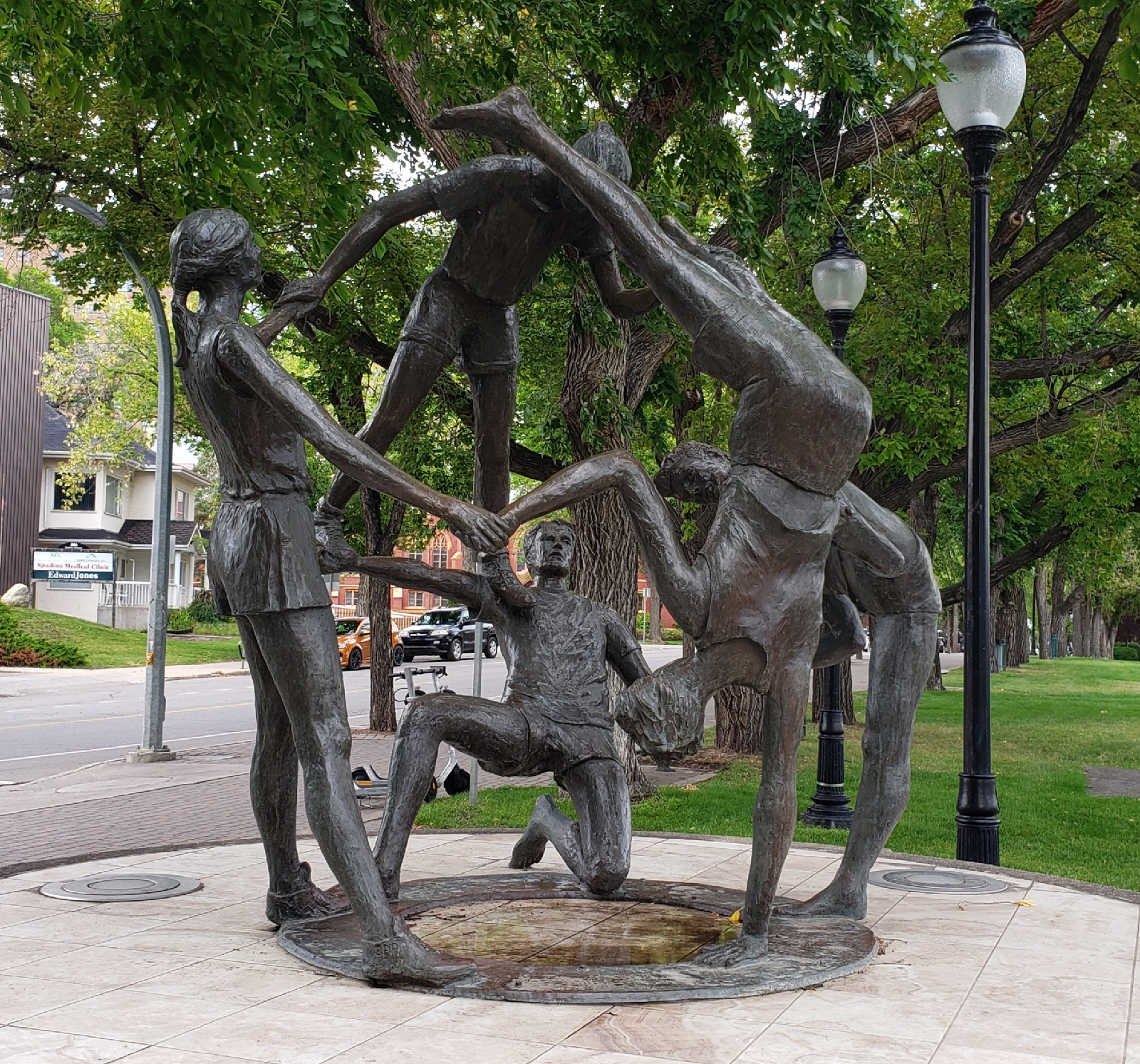
I passed a statue this week (I enjoy public art; whether it's to any one's preference or not is irrelevant as it often elicits discourse and reaction.) 

The statue in question is a collection of individuals, playfully supporting one another in athletic ventures, almost acting like a human sphere. To me, it conveys a sense of motion, of connection, of trust, of collaboration. 

It was fitting I should notice it this week, as I was taking a short break from a project I was working on - a project that necessitated a fantastic team! 

On our team, we each have our role and responsibility, and are working in our specific field. It's a fantastic group of people, who have gone above and beyond in a short span of time to make things happen. 

It's a great team to be a part of! While some of the folks have never met each other, and may not cross paths in future, their efforts were just like that statue: holding up one another, working towards a common goal, trusting, being simultaneously supported and supportive. (As well as laughing in the process, and celebrating together!)

And in the background, we had other folks who had offered to help if we needed. And we were surrounded by praying folks keeping us uplifted to God's grace. (These are important components of the team!)

While it would be easy to credit just the individual skills and efforts of this dream team, our success was rooted in more than that. Because every person who was involved has done this in other teams, and will do it again. It's a fluid reality of being in healthy community.

For me, these folks have shared blessings more than I can describe. I give thanks to God for everything they have done (and will do in future!) 

This is how we build community: with trust and support, with the gifts that are surrounding us and willingly offered, with laughter and love - and with faith.